
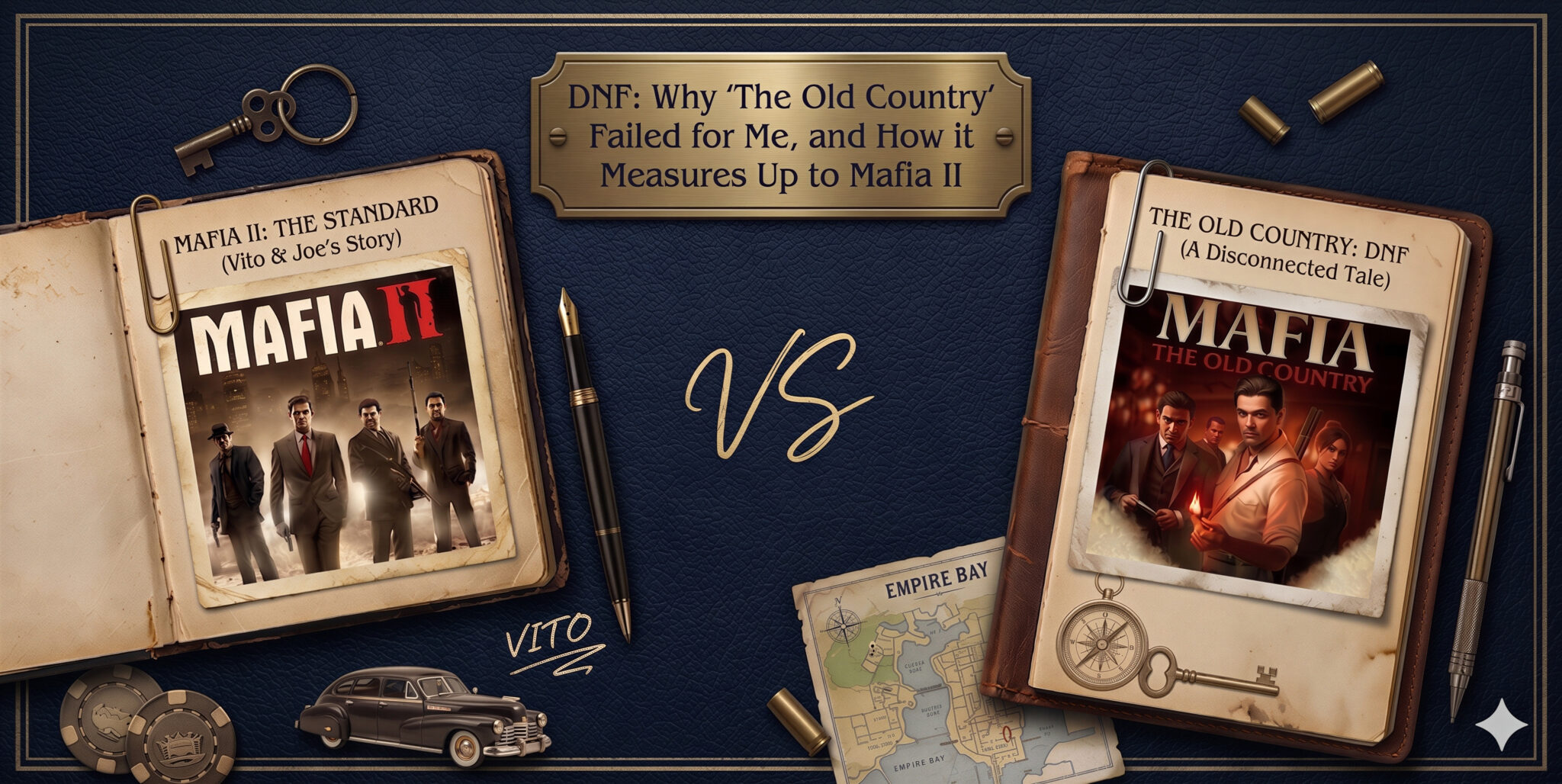
To truly understand exactly what went wrong with Mafia: The Old Country, we first need to look back and understand what made Mafia II an absolute masterpiece.
Mafia II was released in 2010, landing right in the middle of what I consider the golden age of modern gaming. (Don’t believe me? Go look up the legendary titles released between 2009 and 2015).
While it’s true that booting up Mafia II today might make you cringe at the outdated graphics, the story still plays expertly on your heartstrings. I remember how mesmerizing that game was. I spent countless hours in the garage customizing my freshly stolen cars, just to cruise around the map listening to oldies on the radio. Let’s not even mention the sheer amount of in-game currency I spent making sure I looked incredibly sharp for my next assignment, whether it was a grimy manual labor job or an ambush on a factory ordered by the Don.
It was retro heaven. It was essentially GTA set in the roaring 50s, but with a soul.
The Illusion of Choice
Let’s start with the similarities, because on paper, both games share the same linear DNA. You collect cars, you gain reputation within the family to ascend its ranks, and it’s all anchored by a main character trying to get the girl and build a life for himself.
But that is exactly where the similarities end.
Mafia: The Old Country is a never-ending, exhausting cycle: take a long drive to watch a cutscene, complete a stealth mission, and repeat. The only variables that actually change are your locations on the map and the names of your targets.
Yes, the game is beautifully designed, but the story progression locks you into the main quest so aggressively that, quite honestly, I didn’t even consider going for a ride to enjoy the scenery. This strict, linear repetitiveness eats away at any motivation to actually finish the game.
Even the rewards aren’t actually rewarding. Take the collectibles, for example. For a while, I thought I was on some clever, hidden Mafia memorabilia scavenger hunt. That was until I accidentally zoomed in on the map and realized every single collectible was already explicitly marked for me. There is no sense of discovery here—only chores.
When a Game Doesn’t Respect Your Time
As for the narrative itself, it felt like I was playing a video game adaptation of The Godfather. Unfortunately, the main inspiration they took from that cinematic masterpiece was its runtime.
The story progression is agonizingly slow. Honestly, I wouldn’t have minded the slow burn if I wasn’t forced to endure a constant loop of repetitive actions just to get to the next plot point. You aren’t playing a story-driven game; you are grinding through a stealth loop just to earn your next cutscene.
Listen, I know that I am the problem in many cases. Much of this argument is highly subjective, based on personal interpretation and gaming fatigue. But I cannot shake the feeling that this game is fundamentally lacking.
Mafia: The Old Country feels less like a passion project and more like a calculated cash grab attempting to capitalize on a much-loved IP. What worries me most is how this trend of coasting on brand recognition has become the default—not just in the gaming industry, but in the realms of movies and books as well.
If a game expects me to give it 40 hours of my life, it needs to respect my time. This one didn’t.
The Verdict: Beautiful graphics cannot save a hollow, repetitive gameplay loop. Skip the grind and go replay Mafia II.